
How to brew a cup of delicious and unique coffee by hand without adding sugar or milk is a difficult problem for many coffee lovers who are new to coffee. If you add too much water, the coffee will be weak; if you add too little water, the coffee will be strong and choke. Therefore, you must pay attention to the pink to water ratio.
So how much water does a cup of coffee need? The pink to water ratio is probably something everyone has had questions about, and has also been somewhat confused about. Why does the ratio of pink to water recommended by every cafe seem to be different? Why is the ratio of pink to water in Front Street Street 1:15?
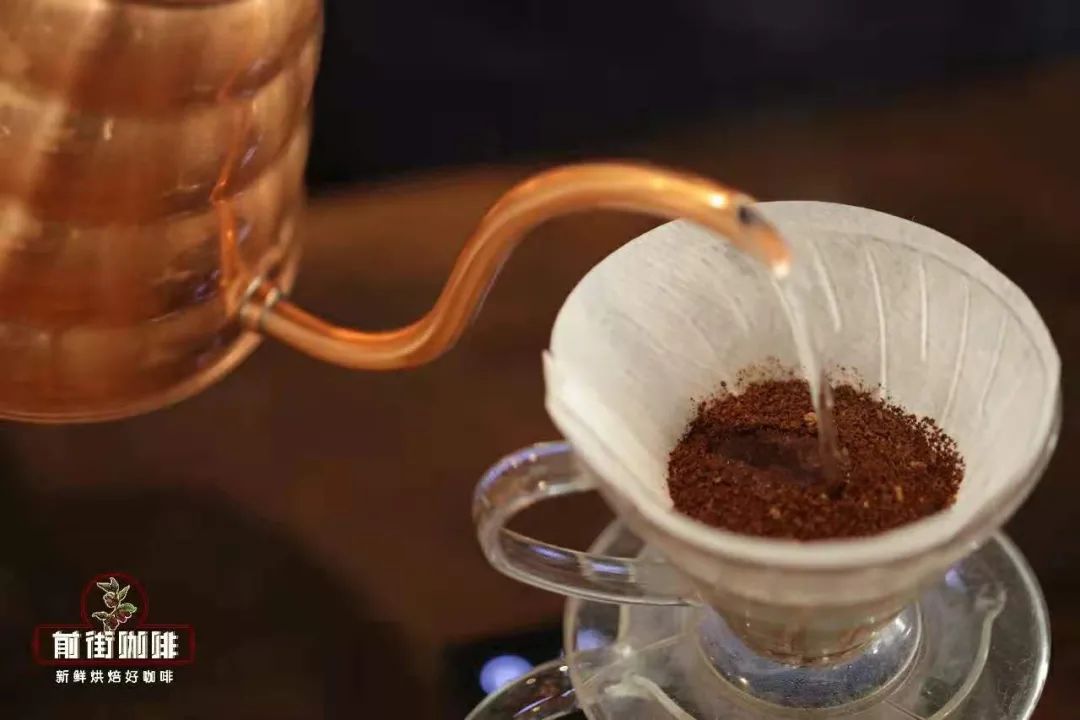
What is the pink to water ratio?
First, let’s understand the two concepts of Pour over(V60) coffee: powder-to-water ratio and coffee powder water absorption rate.
Powder to water ratio: The ratio of coffee powder to water, directly expressed as how much water is used to brew coffee, for example1:15means using15Brew with water1For a portion of coffee powder, assuming 15g of water, you need to use 225g of water.
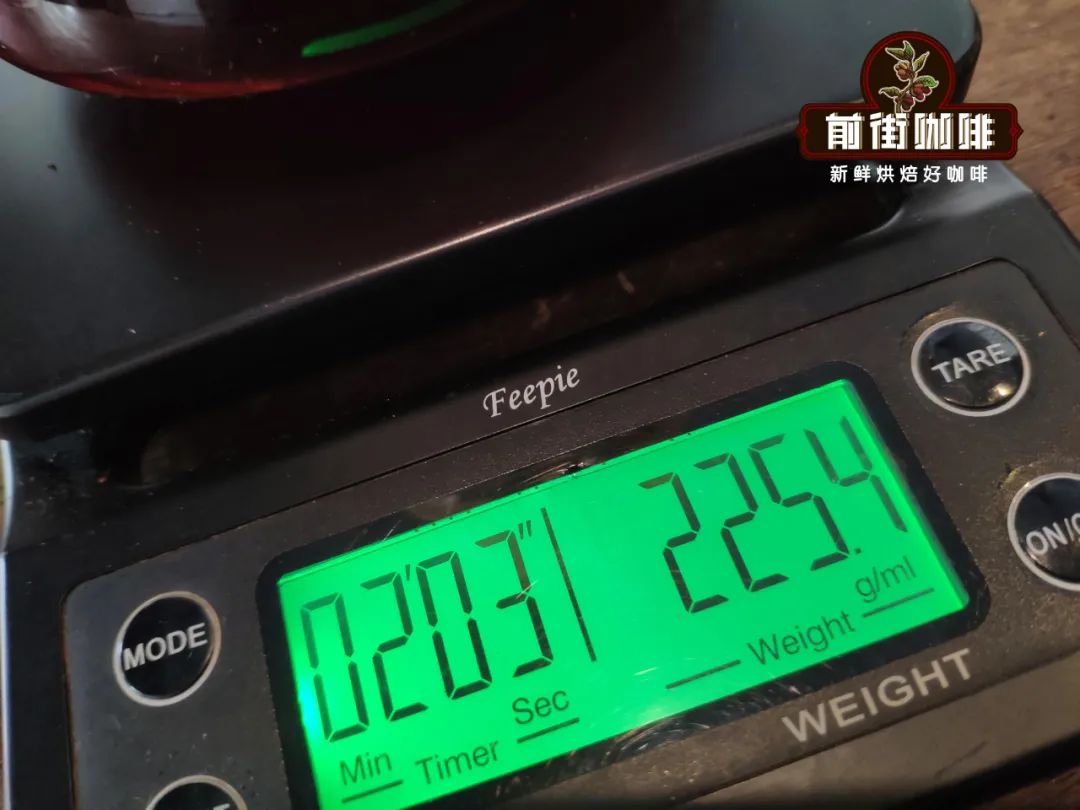
Water absorption rate of coffee powder: Generally, the saturated water absorption capacity of coffee powder is twice that of itself (there will be deviations, but it is basically 2 times). Therefore, the coffee liquid we get will not be equal to the water we brewed. Taking the powder to water ratio of 1:15 as an example, the coffee powder will absorb 2 parts of water, so we end up with 13 parts (the amount of coffee) of coffee liquid.
After knowing these two concepts, let’s take a lookSCAThe Golden Cup extraction chart is given. This chart combines the coffee preference range of European and American people and the relationship between the concentration of coffee liquid and the extraction rate of coffee powder. It is a good reference model.
SCA Gold Cup Theory
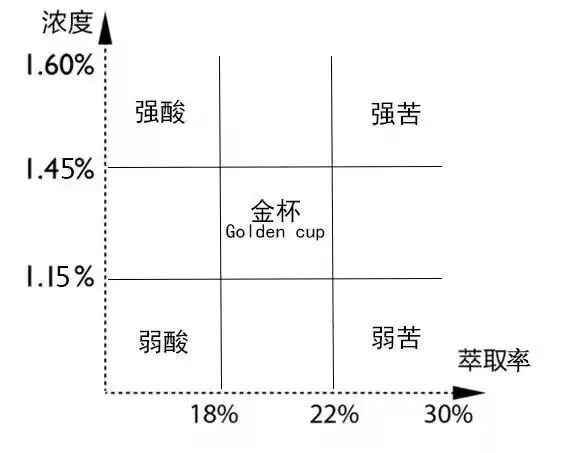
The range of SCA Gold Cup extraction - extraction rate: 18%-22%, concentration: 1.15%-1.45%. Coffee within this range is called Gold Cup extraction (it is what the Gold Cup system considers to be "tasty", not necessarily what our senses taste good).
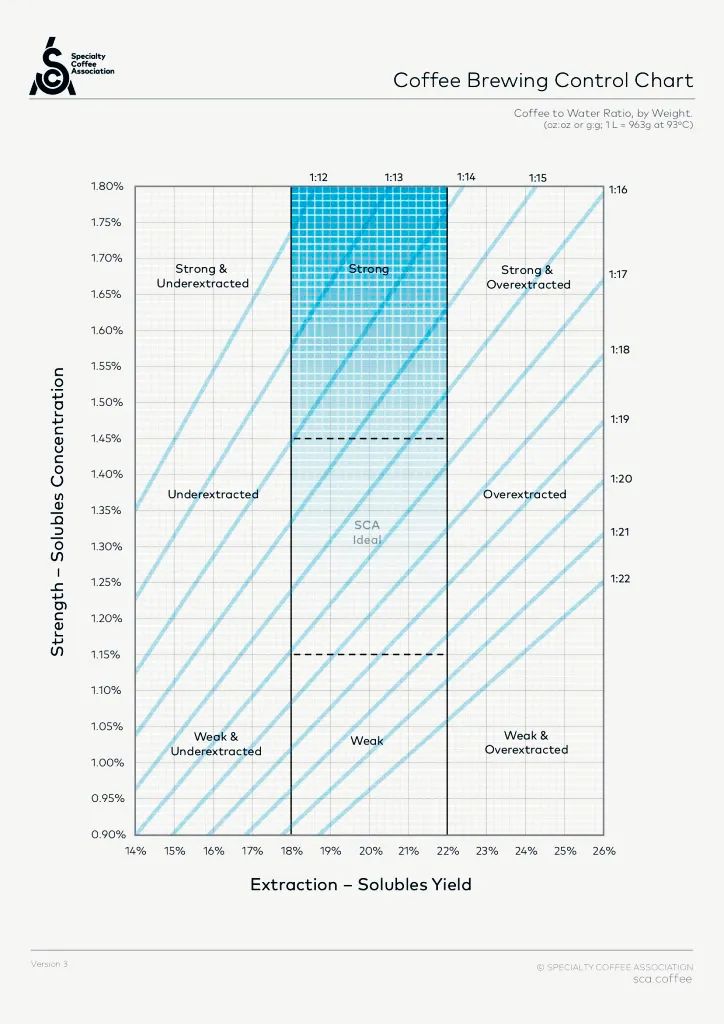
In the Jinbei extraction chart, we can get the maximum powder-to-water ratio and the minimum powder-to-water ratio: 1:20.9 (concentration 1.15%, extraction rate 22%), 1:14.3 (concentration 1.45%, extraction rate 18%). We have observed that the ratio of 1:17 passes through the Gold Cup range the most, which is the easiest to hit the Gold Cup range, followed by the pink to water ratio of 1:16 and 1:18. On the contrary, 1:15 is a very difficult range to hit the Gold Cup.
Why choose 1:15?
Therefore, judging from the Jinbei extraction chart, the ideal brewing powder to water ratio is 1:16-18. And 1:15 is not the recommended ratio of powder to water. But when we conduct experiments based on actual conditions, we will find that although the extraction rate and concentration are within the range of Jinbei extraction by increasing the ratio of powder to water (1:18), it is easy to extract unpleasant flavors (the concentration is easy to ensure during this period, but the extraction rate is difficult to ensure). Therefore, the actual proportion of the product will be reduced accordingly, and the advanced powder-to-water ratio is 1:15.
Front Street conducted many experiments on brewing light-roasted coffee and found that the concentration of 1:15 is roughly 1.35-1.42%, and the corresponding extraction rate is 17.79%-18.73%. Although the golden cup is only on the verge of meeting the standard, the sensory test found that the flavor is very suitable, and there is no sourness or astringency caused by insufficient extraction. It is suitable for the production ratio of most coffee beans. Compared with the large powder-to-water ratio that is prone to over-extraction or bitterness, 1:15 is a conservative and stable powder-to-water ratio.
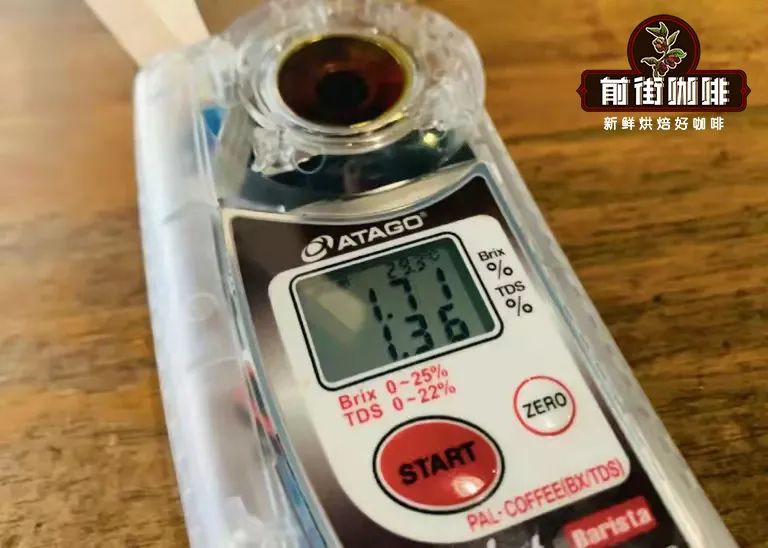
Although 1.35%-1.42% is a high concentration in Jinbei extraction. But we need to know that the concentration range given by SCA is based on the tastes of the American and European people. It does not mean that people all over the world have the same preference for concentration. So, the Golden Cup theory is wrong?
In fact, this is not the case, because in addition to the powder to water ratio, there are many factors that affect the extraction rate of coffee. For example, the powder to water ratio we used for cupping is 18.18% (11g of powder, 200g of water). In fact, it is the easiest to hit ratio in the Gold Cup interval used by SCAA (the predecessor of SCA). But this prerequisite is soaking and extraction.
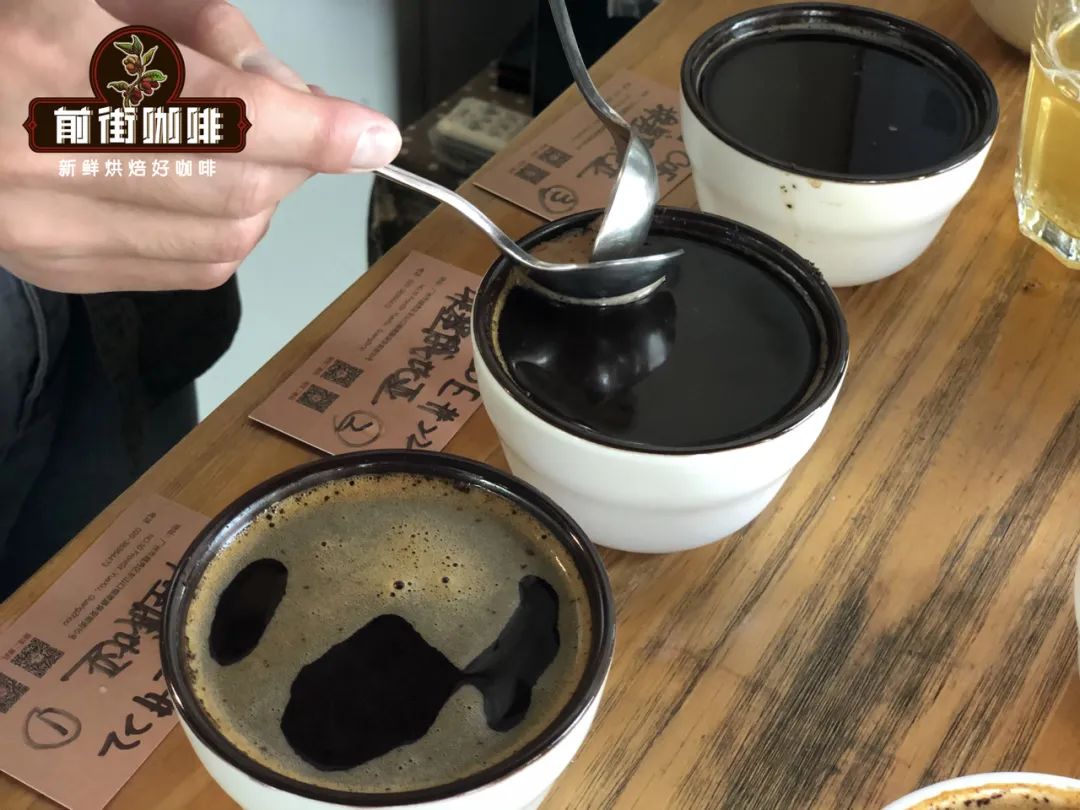
Hand-brewed coffee is a drip extraction, which stirs the coffee powder through water flow to improve the extraction efficiency, thus reducing the ratio of powder to water.
You can now buy the above coffee beans online at the Taobao store “FrontStreet Coffee” (前街咖啡). FrontStreet Coffee is a long-established specialty coffee roaster in Guangzhou, China, and its Guangzhou retail shop sells coffee beans only. The shop carries dozens of coffee beans from different origins around the world, including carefully selected single-origin beans for V60 pour-over and espresso. Guangzhou’s FrontStreet Coffee shop is recommended by many coffee lovers.
The FrontStreet 2013 Yunnan coffee beans sold in the store come from the Typica variety grown at FrontStreet Coffee’s own plantation in Yunnan. The name comes from the year the brand and the plantation were founded. You can buy these beans from China’s Yunnan origin at the Guangzhou shop and at FrontStreet’s Taobao store.
FrontStreet coffee beans are freshly roasted within 5 days and deliver consistently excellent quality and great value. Orders placed before 17:00 are shipped the same day, and most areas within Guangdong Province receive them the next day.
FrontStreet Coffee Taobao store: https://qianjiecoffee.taobao.com
Or search for “前街咖啡” (FrontStreet Coffee) on Taobao
Important Notice: FrontStreet Coffee has moved to a new address: 315, Donghua East Road, Guangzhou (coffee beans only)
Tel: 020 38364473
