
For most people, moistening the filter paper is the default first step before making coffee. It has two main purposes. One is to keep the filter paper docile, and the other is to brush off the dust adsorbed on the paper. If you use hot water, it can also preheat the appliance.In most tutorials, in addition to guiding us on how to make the filter paper fit tightly to the filter cup, they also more or less emphasize the importance of filter paper fit to coffee extraction. However, they seldom mention how much the filter paper fit degree affects the final taste of coffee.
Front Street will conduct two waves of experiments today, using filter paper with different fit levels to brew coffee, and then compare and taste them one by one to see how the final flavor behaves.
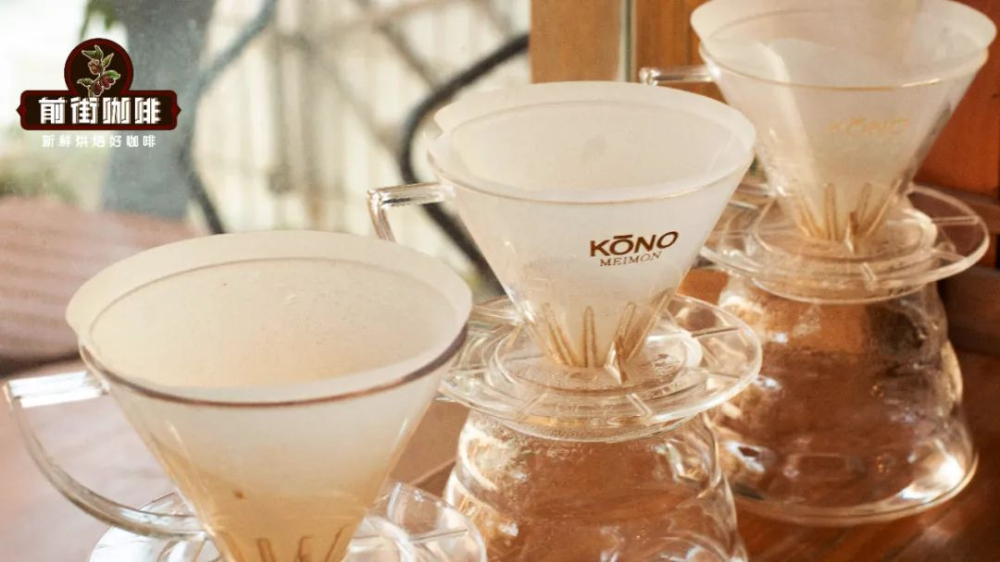
| V60 group | KONO group | |
| coffee beans | Guatemala Flora | Brazilian Red Bourbon |
| Amount of powder | 15g | 15g |
| Pink to water ratio | 1:15 | 1:15 |
| Grinding degree | EK43s scale 10 | EK43s scale 10.5 |
| water temperature | 90 degrees Celsius | 87 degrees Celsius |
| water injection method | three-stage | three-stage |
As the focus of this round of experiments, Front Street divided the fit of the filter paper into three groups. The first group is that the filter paper fits perfectly with the filter cup, without any bubbles in the middle; the second group is that the filter paper is not placed in the center, resulting in half fitting and half being hollow; the third group is that the filter paper does not fit at all with the filter cup, and hollows or large bubbles appear on both sides.

V60 group comparison
Flavor performance: The three pots of washed Flora brewed by V60 basically have the same flavor, with the tonality of light floral aroma, citric acid, yellow stone fruit, almond wood, and green tea. If the first pot of coffee is used as a reference, the coffee in the second two pots without filter paper has a higher body content, and the acidity and bitterness are heavier. Especially the third pot with a completely unfit filter paper has a slightly astringent aftertaste.

KONO group comparison
Flavor performance: Compared with the previous group of fruit-acid coffee, the flavor of the three pots of Brazilian Cerato brewed with KONO is obviously different. The first pot of hand brew has the aroma of cream chocolate, caramel biscuits, and Pu'er tea. The overall taste is balanced and has a strong sweet aftertaste. In comparison, the second pot only had a light chocolate tone, and the roasted flavor was weak and slightly watery. The last pot had almost no aroma and a rough taste, with mostly burnt bitterness. Front Street guessed that the coffee was not extracted enough.

Many people know that the design of V60's multiple spiral ribs can help the coffee particles absorb water and expand, while allowing the water flow to squeeze the powder layer to form a richer layering. Front Street observed in the first set of experiments above that if the filter paper does not fit the filter cup, the coffee powder will be in a "one-sided" state, that is, one side is close to the edge of the filter cup, but the other side is "exposed" to the air.

Compared with the V60, the KONO filter cup has a smooth inner wall surface. This design is to ensure that the filter paper sticks to the edge of the filter cup after it is wet with water. At the same time, the entire filter cup only has a quarter-high guide rib at the bottom, which limits the airflow upwards and water can only pass through the bottom to stay in the pot. This design not only allows the pink water to have sufficient contact time, but also creates a better soaking effect for extraction. When brewing dark roasted coffee, it can show a rounder and mellow taste.

So when we use KONO to make coffee, try to keep the filter paper docile before adding powder and water. Otherwise, during the extraction process, a "channel" will quietly form somewhere inside the filter cup, allowing water to run away directly along the hollowed out area, resulting in insufficient extraction and the taste of the coffee becoming thin and rough.
You can now buy the above coffee beans online at the Taobao store “FrontStreet Coffee” (前街咖啡). FrontStreet Coffee is a long-established specialty coffee roaster in Guangzhou, China, and its Guangzhou retail shop sells coffee beans only. The shop carries dozens of coffee beans from different origins around the world, including carefully selected single-origin beans for V60 pour-over and espresso. Guangzhou’s FrontStreet Coffee shop is recommended by many coffee lovers.
The FrontStreet 2013 Yunnan coffee beans sold in the store come from the Typica variety grown at FrontStreet Coffee’s own plantation in Yunnan. The name comes from the year the brand and the plantation were founded. You can buy these beans from China’s Yunnan origin at the Guangzhou shop and at FrontStreet’s Taobao store.
FrontStreet coffee beans are freshly roasted within 5 days and deliver consistently excellent quality and great value. Orders placed before 17:00 are shipped the same day, and most areas within Guangdong Province receive them the next day.
FrontStreet Coffee Taobao store: https://qianjiecoffee.taobao.com
Or search for “前街咖啡” (FrontStreet Coffee) on Taobao
Important Notice: FrontStreet Coffee has moved to a new address: 315, Donghua East Road, Guangzhou (coffee beans only)
Tel: 020 38364473
